Best Movies About Letting Go of Control
Best Movies About Letting Go of Control
Letting go is one of the hardest spiritual practices. Not because it's difficult to understand—you know intellectually that control is an illusion—but because releasing it feels like stepping off a cliff. These films show you characters learning what happens on the other side. They don't preach surrender. They show the vertigo of releasing your grip and discovering, to your surprise, that you don't fall. That you land somewhere better.
Why Letting Go Matters — Beyond the Struggle
Most of us spend our lives trying harder. We optimize, fix, control, engineer the outcomes we want. We believe that if we're smart enough, disciplined enough, vigilant enough, we can prevent suffering and create the life we imagine. This belief runs so deep it feels like truth.
But there's a cost. The constant effort to control exhausts you. You're always braced, always vigilant, always one step ahead of disaster. You can't rest because rest means losing control. You can't receive because receiving means admitting you're not in charge.
Letting go of control doesn't mean giving up. It means recognizing that you're not the only force shaping your life. It means acknowledging that some things—other people's choices, circumstances, the passage of time—aren't yours to control. And that acknowledgment is liberating. When you stop trying to engineer everything, something shifts. You begin to notice what's actually happening. You become available to surprise, to connection, to the unplanned moments that often turn out to be the ones that matter most.
The films on this page are about that shift. They show characters discovering that the life they tried so hard to control was less alive than the life that unfolds when they finally let go.
The Paradox of Surrender in Mindfulness Practice
In mindfulness traditions, control and resistance are seen as the root of suffering. You suffer because you're gripping—holding tight to outcomes, refusing what is, fighting against the present moment. The practice is simple: release the grip. Stop fighting. Let things be as they are.
But this isn't passive. Letting go isn't resignation or defeat. It's a precise, active choice to stop using your energy for resistance and redirect it toward presence. You're not giving up on your values or your life. You're giving up on the idea that you can force life into the shape you imagined.
The difference is subtle but profound. A person who has let go can still act, still care, still commit. But they're not brittle. They're not invested in a specific outcome. They're invested in showing up fully and trusting what happens next.
The films that work as tools for this practice are the ones that show the moment of release—when a character stops fighting and discovers that the ground is still there.
Films That Show the First Release
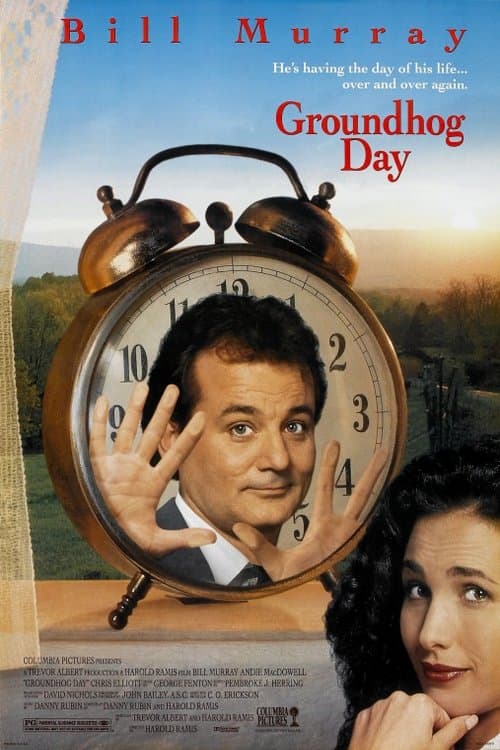
Groundhog Day is the scripture of letting go. A man wakes up to the same day, repeating infinitely. He panics. He rages. He tries everything to escape. But escape is impossible. The only freedom comes when he stops fighting the repetition and begins to live it. He stops asking "How do I get out?" and starts asking "Who can I become while I'm here?" The shift happens gradually. One day, he notices the sunrise. Another day, he helps someone. By the end, he's not trapped—he's free. Because he stopped insisting that the day be different and started being present to it exactly as it is.
Palm Springs takes that premise into territory that's bleaker and more beautiful. Two people trapped in a time loop, repeating the same day forever, gradually recognize that escape is impossible. There's no trick, no exit. There's only this day, again. The film doesn't offer false hope of breaking free. It offers something deeper: the discovery that connection and meaning are possible within the loop. That acceptance isn't the consolation prize. It's the only thing that was ever real.
Films That Show Learning You Can't Fix
The Butterfly Effect is about a man who discovers he can travel back and change traumatic moments from his past. He tries. Each time he changes something, he returns to a present that's radically different—and usually worse. He's not saving his original timeline. He's creating new suffering in new timelines. The film asks a painful question: If every change you make branches reality, and you can never undo the original wound, what does healing look like? The answer: acceptance. Not the acceptance that comes from resignation, but the acceptance that comes from recognizing that you can't fix what's already happened—you can only move forward from where you actually are.
Everything Everywhere All at Once is chaos and surrender woven together. Evelyn is a woman trying to control everything—her business, her daughter's life, her own path. She discovers that infinite versions of herself exist in infinite universes, each having made different choices. The more she tries to find the "right" universe, the more she fragments. The breakthrough comes when she stops searching for the perfect version of herself or her life and instead surrenders to radical kindness and acceptance. The most transformative act isn't control—it's surrender.
Films That Show Surrendering to What Is
Cloud Atlas spans centuries and shows the same consciousness recurring in different lives, across different times and places. The film asks: if identity persists across incarnations, what are you really trying to control? Not your body, because that changes. Not your era or circumstances, because those are beyond you. What remains is something deeper—a continuity of awareness that moves through lives beyond your control. The inner shift is recognizing that you're part of something larger than your individual will.
Arrival is about learning a new language and discovering that language rewires how you perceive time itself. The protagonist doesn't just translate an alien language—she begins to perceive time the way the aliens do: nonlinearly, all moments existing at once. She sees her future clearly, including tragedy. The film asks: if you could see your entire life at once, would you still choose it? Her answer—yes—is an act of surrender to what is, what will be, what has been. She's not trying to change her fate. She's accepting it completely, and in that acceptance, finding peace.
Interstellar is about a father learning to let go of his daughter. He travels through a wormhole to save humanity, experiencing time at different rates than she does on Earth. By the end, decades have passed for her while only years have passed for him. He learns that he can't protect her, can't control her life, can't stay. All he can do is love her and trust her to live without him. The shift is from control to love, and the realization that these are opposite forces.
Films That Show Freedom in Acceptance
Soul is a quiet masterpiece about a jazz musician so obsessed with achieving his one big dream that he misses his actual life. The film shows him learning that life isn't a single destination you're trying to reach. It's the accumulation of small moments—a conversation, a meal, the feeling of your fingers on piano keys. When he stops trying to force one perfect outcome and instead surrenders to the everyday, ordinary moments, he discovers that those moments were never the consolation prize. They were the point all along.
About Time (cross-referenced from our time travel collection) explores this from another angle. A man discovers he can travel back through his own timeline to fix moments. But as the film progresses, he realizes: the moments worth living aren't the ones you optimize. They're the ordinary ones you were too busy trying to improve to notice. He learns to let go of the fantasy of a perfect life and start living the actual one he has.
How to Watch — Creating Space for Surrender
These films work best when you bring your own struggle with control into the room. Notice where you're gripping in your own life. Where are you trying to force an outcome? Where are you refusing to accept what is?
Watch with that awareness. Let the characters' journeys mirror your own. When you feel the vertigo of letting go—watching a character release control and not knowing what comes next—sit with that feeling. That's where the shift lives. That's the film doing its work on you.
After watching, sit for a moment. Don't reach for distraction. Notice what changed in how you see your own situation. What would it mean to let go of this one thing you're trying to control?
Frequently Asked Questions
What's the difference between letting go and giving up? Letting go is active. You're still engaged with your life; you're just not trying to force a specific outcome. Groundhog Day shows this perfectly—the protagonist doesn't give up on living. He stops fighting the day and starts fully inhabiting it. Giving up is passive—you stop caring. Letting go is the opposite: you start caring in a different way.
Can I practice letting go in my ordinary life? Absolutely. Start small. What's one thing you're trying to control that you could release? A conversation you keep replaying, trying to fix it. A relationship outcome you're invested in. A detail about how your day "should" go. Practice releasing that grip. Notice what happens when you stop. That's the practice these films are showing you.
Why do these films feel spiritual instead of depressing? Because they end with freedom, not defeat. The characters who let go aren't broken—they're awake. They're alive in a way they weren't before. The shift from control to acceptance isn't tragic. It's liberating. And that liberation is what makes these films spiritual rather than dark.
How does surrender lead to freedom? When you stop using all your energy to control outcomes, you have energy for everything else. You can notice. You can listen. You can receive. You can be surprised. You can connect. All of that becomes possible when you release your grip on how things "should" be.
Explore Related Themes
Each film on this page belongs to deeper thematic territories. Explore them:
- Letting Go of Control — Surrender, acceptance, and the strange freedom in releasing the grip
- Acceptance — Making peace with what is
- Awakening — The movement from autopilot to seeing clearly
You might also read:
- Mind-Bending Movies That Challenge Reality — Films as Tools for Awakening, which explores the philosophy behind our entire collection
- Movies That Make You Question Reality, which organizes films by the dimension of reality they question
- Time Travel Movies for Deep Thinkers, which explores how non-linear time becomes a tool for releasing control
What would it mean to stop fighting for one day? Not to give up on your life, but to release your grip on how it's supposed to unfold? These films offer that experience. That's why they matter.