Movies About Identity — Films That Ask Who You Really Are
Movies About Identity — Films That Ask Who You Really Are
Memory is the thread that holds identity together. Remove it, question it, or discover it's false—and the self unravels. These films strip away the stories you tell about who you are and ask a terrifying question: without those memories and narratives, do you exist at all?
Why Memory Is Identity — The Thread That Holds the Self Together
You think of yourself as a continuous being. You have a history, a personality, a set of experiences that make you you. But what actually holds all of that together? Memory. Without it, you have no past. Without a past, you have no narrative. Without a narrative, you have no identity.
This is the terrifying insight at the heart of identity dissolution. You're not a solid thing. You're a story you tell yourself every day—a story built entirely from memories, most of which you don't even question. You inherited some of this story from others: your family, your culture, your conditioning. You invented parts of it: the narratives you've constructed to make sense of your experiences. But all of it—inherited and invented—rests on a single foundation: memory.
What happens when that foundation cracks?
These films explore that question. They show you characters discovering that the memories they relied on to know who they are either don't exist, never existed, or aren't what they thought. And in that discovery, identity doesn't just shift. It dissolves. The character—and you, watching—experience what it means to have the ground beneath the self disappear.
This isn't a comfortable experience. It's meant to unsettle you. Because once you've watched a character discover that their fixed sense of self was always dependent on a constructed narrative, you can't help but ask: What memories am I relying on? How much of my identity is real?
Films Where Memory Loss Dissolves the Self
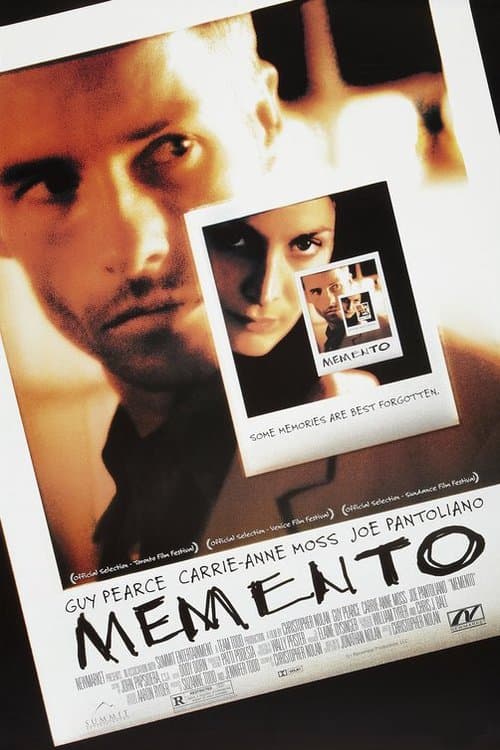
Memento is about a man who can't form new memories. He wakes up each morning and builds his sense of who he is from notes, photographs, tattoos—external scaffolding for an internal absence. But here's what breaks your heart: without memory, without the continuous thread of experience, he doesn't actually exist. He's fragments. He's a narrative he has to reconstruct every day. By the end, you realize: he is what we all are, just more honest about it. We're all amnesiacs living on the edge of forgetting who we are.
Eternal Sunshine of the Spotless Mind takes memory dissolution further. A man undergoes a procedure to erase all memories of a relationship. As the procedure unfolds and his memories of her disappear, something else disappears too: the version of himself that existed within that relationship. He watches his own identity being unmade. The film doesn't show this as relief. It shows it as loss. The inner shift is recognizing that you don't exist separately from your relationships and memories. You are those connections. Remove them, and you remove yourself.
Films Where False Memories Shatter Identity
Blade Runner 2049 asks a question that goes deeper than memory loss: What if your memories aren't yours? A replicant—an artificial being—lives with memories he believes are his own. They feel real. They define him. They make him feel human. But what if they were implanted? What if every moment he treasures, every experience that makes him him, was engineered by someone else? The film doesn't answer this question comfortably. It leaves you sitting with the vertigo: if your memories are false, are you false? If your identity is built on a lie, does it matter that the lie feels true?
Oblivion explores the same territory from a different angle. A man works on a post-apocalyptic Earth with fragmented memories of a life before. Gradually, he discovers those memories aren't his. They were implanted. The identity he's been living—the person he thought he was—was constructed for him by forces beyond his control. The inner shift isn't plot revelation. It's the slow, aching realization that the self you trust can be entirely false. That who you are might be a role someone else wrote for you.
Shutter Island approaches this from yet another angle: What if the false memories you've constructed are the only thing keeping you sane? A man arrives at an asylum with fragmentary memories of trauma. Gradually, he discovers his memories don't align with reality. But the film asks something more profound: if accepting the truth destroys you, and the false memory keeps you alive, which version of identity matters? The shift is recognizing that sometimes we construct false identities—false memories, false narratives—not out of malice but out of survival. And that doesn't make the identity less real. It makes it more human.
Films Where Identity Merges and Fragments
Black Swan shows identity dissolving not through memory loss but through ego-death. A dancer preparing for a role begins to lose track of where she ends and the character begins. The boundaries between self and performance collapse. By the end, you can't tell which is her and which is the swan. The film suggests something terrifying: identity is a performance so convincing you believe it's real. And if the performance is convincing enough, the distinction between the real you and the character you're playing becomes meaningless.
Fight Club reveals a fractured identity hidden beneath the surface of a single, unified self. A man thinks he knows who he is until he discovers he's been living alongside another personality—a version of himself he didn't know existed. The identity he trusted was always divided. The shift is realizing: how much of you is real, and how much is a character you've constructed? How many selves are hiding inside the one you call yourself?
Mulholland Drive fragments identity across timelines and realities until you can't tell which version of the protagonist is real. Is she the young actress arriving in LA with dreams? Is she the successful director looking back? Are both real? Neither? The film doesn't resolve this. It asks you to sit with the possibility that identity isn't a single fixed thing—it's a collection of possible selves, and the one you experience depends on which memory, which timeline, which narrative you're currently inhabiting.
How to Watch — Preparing for Identity Dissolution
These films work best when you bring your own questions about identity into the room. Notice where you feel most solid in your sense of self. Notice which memories you rely on to know who you are. Then watch a character discover that very foundation cracking—and feel what happens in you.
You might feel disoriented. You might feel a kind of vertigo, a loosening of something you thought was fixed. Don't rush to explain it away. Sit with that feeling. That's where the shift lives.
After watching, sit for a moment without distraction. Notice what changed. Notice if you're questioning any of your own assumptions about who you are and whether those assumptions rest on solid ground or on the fragile foundation of memory.
Frequently Asked Questions
What happens to your sense of self when you lose your memories? Watch Memento. It shows you directly. Without memory, there's no narrative. Without narrative, there's no identity—only fragments you have to piece together each day.
Can identity exist without memory? That's the question these films ask without answering. What they suggest is: maybe identity is just the story memory tells. Remove memory, and you remove the story. What remains? Consciousness, perhaps. Awareness. But not identity as you understand it.
How do false memories change who you are? They make you someone else entirely—even if you don't know it. Blade Runner 2049 and Oblivion show this. If your memories are false, your identity is false. But here's what's troubling: you won't feel false. You'll feel entirely like yourself. Because that's what identity is—the story you believe about yourself.
What's the difference between discovering yourself and losing yourself? These films suggest the difference might be smaller than you think. Sometimes discovering who you really are means losing the identity you thought was real. Sometimes they're the same thing.
Explore Related Themes
Each film on this page belongs to deeper thematic territories. Explore them:
- Identity Shift — The moment the self becomes less solid
- Memory and Self — When memory is edited or unreliable, who is left?
- Awakening — The movement from autopilot to seeing clearly
You might also read:
- Mind-Bending Movies That Challenge Reality — Films as Tools for Awakening, which explores the philosophy behind our entire collection
- Movies That Make You Question Reality, which organizes films by the dimension of reality they question
- Movies About Simulation and Illusion, which explores constructed realities as tools for awakening
Who would you be without your memories? Not as a philosophical question, but as a felt experience. These films offer that experience. That's why they matter.