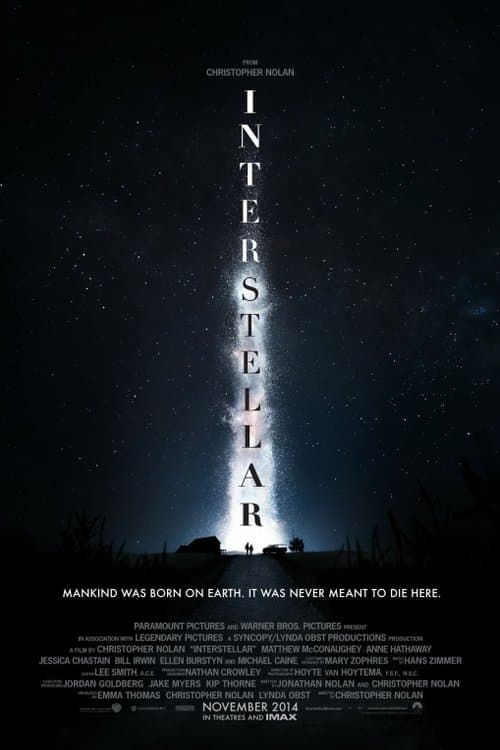
Interstellar Ending Explained — What the Film Asks of You
Interstellar Ending Explained — What the Film Asks of You
Most people searching "Interstellar ending explained" want the wiring diagram: how the final act works, who built what, whether the physics holds. That explanation exists and it is not hard to find. It also explains almost nothing about why a film about orbital mechanics leaves so many viewers thinking about a phone call they have not returned.
Why "Interstellar Ending Explained" Is the Wrong Place to Start
The mechanical reading of the ending is available, internally consistent, and slightly beside the point. You can work out the causal structure of the last half hour on a second viewing, and many viewers do. What that exercise cannot account for is the feeling that arrives with it — a specific, uncomfortable recognition that has nothing to do with gravity.
Interstellar is built so that its most technical sequence is also its most domestic. The film spends two hours establishing scale — light years, event horizons, the indifference of physics to human preference — and then resolves it at the scale of one parent and one child in one room. That inversion is the design, not a sentimental compromise at the end of a hard science film.
So the question worth asking is not what happened. It is why the film routes an answer about the universe through an answer about a family, and what it expects you to do with that once you notice.
What Interstellar Is Really Asking You to Sit With
Strip out the spacecraft and this is a film about time as a finite quantity you are spending on specific people, mostly without deciding to.
Its cruelest idea is not that time dilates. It is that the cost is invisible while you are paying it. The characters do not experience their losses as they occur. They experience the accumulated bill, all at once, much later — and by then nothing can be renegotiated. That is a science fiction premise only in its packaging. It is a plain description of what it is like to be forty and realize what a decade of a particular kind of work actually cost, or to understand a parent's absence only after you have replicated it.
You have almost certainly done a version of this. Taken the assignment, the shift, the second job, the degree, the move — a defensible choice, made for people you love, that also removed you from those people during years that did not come back. The film refuses to call that a mistake. It also refuses to let it be free.
This is where Arrival makes a useful contrast. That film asks whether you would still choose a life knowing its cost in advance. Interstellar asks something less elegant and more common: what do you do when you did not know, cannot go back, and have to keep being a person anyway. 12 Monkeys circles the same wound from the direction of inevitability, but with none of Interstellar's insistence that the effort still counted for something.
The Loop the Film Builds, and What It Says About Agency
The structural trick of the ending — an outcome that appears to cause its own conditions — has been argued over since release, usually as a physics problem. Treated as a physics problem it is a curiosity. Treated as a claim about how people actually live, it is the sharpest thing the film says.
The argument the structure makes is this: you do not get to know, from inside your life, whether you are choosing or completing something. The characters act with full conviction and turn out to have been part of a shape they could not perceive. Their agency was real. So was the pattern. The film declines to rank them.
Most of us hold those two accounts separately and switch between them depending on the outcome. Good results become our decisions; bad ones become circumstance. Interstellar puts both in the same frame and leaves them there. The Adjustment Bureau makes this a literal negotiation with an external authority, which is the easier version of the question. Cloud Atlas spreads it across centuries until the individual choice nearly disappears. Interstellar keeps it at one lifetime, where it is harder to dismiss, and where it might mean something about yours.
What Interstellar May Shift in You
This film may change how you account for the time you have already spent. Watching this, you may find yourself doing arithmetic you have been avoiding — not out of regret exactly, but with a new clarity that the years you allocated to something were, in fact, allocated, and that you were the one doing it.
It may also loosen the assumption that love is the soft part of a hard decision. The film treats attachment as information: a real signal about what matters, worth acting on even when it cannot be justified in the terms your circumstances are demanding. If you have ever discounted a pull toward a person because you could not defend it on paper, the film is making a quiet argument against that habit.
There is a third shift, and it tends to arrive later than the others. Interstellar may make you less interested in being understood in the moment and more interested in what you are actually leaving behind. Its characters work on evidence they will never see received. Much of a life looks like that — effort sent forward with no confirmation. Eternal Sunshine of the Spotless Mind reaches a similar place from the opposite direction, asking what survives when the record itself is removed.
Where to Go After Interstellar
If what stayed with you was time as a resource rather than a setting, our time travel theme page gathers films that treat it that way. If it was the harder feeling underneath — that you cannot control the outcome of what you set in motion, only whether you set it in motion honestly — our letting go of control theme page is the better next stop. For the agency question specifically, free will and fate collects films built on the same tension.
For a next film rather than a next idea, our movies like Interstellar collection traces the love-across-time thread through six further titles, and our Christopher Nolan films ranked by what they shift in you places this one against the rest of his work on exactly this axis. If what you want is more of the unresolved-ending discomfort, our readings of Annihilation and Donnie Darko take the same approach to two films that have resisted decoding even longer. And if the dream-logic layer is what caught you, Inception asks a neighboring question about which reality you would choose to be accountable to.
Frequently asked questions
What does the ending of Interstellar mean?
The mechanical explanation is available and coherent, but it is not what the ending is for. The film routes a question about the scale of the universe through a question about one relationship, arguing that attachment is real information rather than a weakness in an otherwise rational decision. Watching Interstellar for the physics answers the smaller question.
Is the ending of Interstellar a paradox?
Structurally it is a closed loop, and yes, that is deliberate. Argued as physics it stays unresolved. Read as a claim about living, it says something plainer: you cannot tell from inside your own life whether you are choosing freely or completing a pattern, and the film refuses to say which matters more.
Is Interstellar's ending sad or hopeful?
Both, and it does not resolve the tension. What it recovers is not the time that was lost — that stays lost — but the meaning of having spent it. Viewers who find it hopeful and viewers who find it devastating are usually responding to the same scene.
What movies are like Interstellar?
Arrival is the closest companion for its treatment of time and love as the same question. 12 Monkeys shares the loop structure with a colder verdict, and Cloud Atlas widens the same idea about consequence across centuries.
Do you need to understand the physics to understand Interstellar?
No. The physics is scaffolding for a question about attachment and time that the film states clearly in ordinary language. Viewers who follow the science closely and viewers who ignore it entirely tend to arrive at the same place emotionally, which is a reasonable sign of where the film's actual argument lives.
Interstellar was never going to resolve into a clean diagram, and by now you may see why the diagram was never the point. If it surfaced an account of your own spent time that you would rather not open, notice that the film does not ask you to fix it — only to stop pretending it was free.
Want one film like this every Friday? Join the Friday MindShift.